
 716-337-3760
Products that had a lot of potential, but never went anywhere.
New/Old Inventory
As a member of a family that owns a few small business here in Western New York, we’ve gotten behind many products over our 60+ year history that we thought, for sure, were going to be big sellers. “The next best thing since sliced bread,” so to speak. I don’t know what happened. It’s hard to say. It could have been bad marketing on my part. Maybe, we didn’t put enough money behind some of these product launches. Or, it could have been that we misjudged the market. It also could have been that we were a little ahead of the market, ahead of our time. The reasons products fail almost always involve price, to a certain degree. I’m sure it was a combination of many factors. The bottom line is that today we have a bunch of orphaned products, sitting on our shelves that never went anywhere taking up space and collecting dust. The Air-Prune Tray is one such product.
Meet The Inventor
Allow me to explain how air-pruning works, or how it is supposed to work, and how the inventor thought this tray was going to revolutionize the transplanting industry. This all started back in 2001. A gentleman by the name of Dr. Barney K. Huang developed a method of propagating vegetable transplants in the greenhouse environment he called “root air-pruning.” The late Dr. Huang, who at the time was a Distinguished Professor at Braden University, wrote a short white-paper on the technology which you can view/download here. It explains the process quite well.
For the sake of this blog, I’ll give you the condensed version.
Air Pruning 101
First, you must be aware that these trays are not unique. Air-pruning pots and trays are still around today, in many different configurations. But, they never truly caught on in large commercial growing operations, which is where our agricultural equipment operates. When I say large, we’re talking hundred and in some cases thousands of acres under cultivation. The trays were expensive and difficult to work with because you needed to separate the screen from the tray, and then quickly remove the seedling from the tray in order to insert it into a transplanter, which in turn plants it into the ground. This all happens in a systematic way, in real time. Operators of these various transplanters sit or stand on these machines and feed seedlings into cups or carousels as they are moving down a row. The other problem for our transplanter in particular is that we require a substantial root system, which has a little weight and mass to it. This is important so the seedling orients properly in the jaw, before it goes into the ground. A bare root plant is not going to cut it.
Tray Configuration
This tray, in its current configuration, measures 23-½” long by 12-½” wide. It is a 200-cell tray with each cell measuring 1” square x 1” deep. The tray is manufactured using injection molding and made from a very durable and rigid polymer. Each tray and screen combination can be reused indefinitely. The air-pruning system consists of two parts: The plant receptacle and the air-pruning screen. (See Figure 1. below) Do not be concerned by the size of the planting cell. There is ample room available to produce a very robust root system.
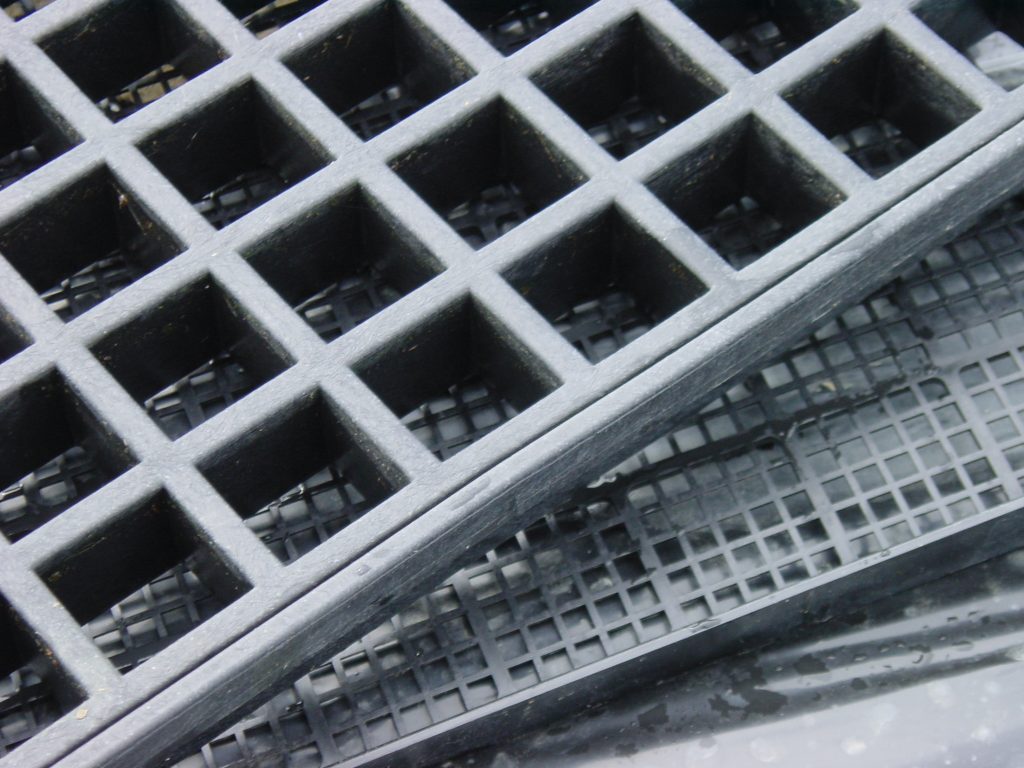
Figure 1.
How Does It Work?
In the example below (Figure 2) we offer a side-by-side comparison on the differences between the air pruning tray and a conventional tray. It all comes down to root branching. As the plant grows in the air prune tray, the root system develops until it comes in contact with the bottom screen, or air. Sensing that it is out of room to expand further, it propagates more branches, or root tips. What develops is a larger, more robust, seeding with a complex root system. In the diagram on the right, you can see that with no bottom screen the plants senses that it can continuously grow a single branch that eventually gets tanged up at the bottom of the tray, wasting valuable cell space and growing media. This method produces a smaller, under developed seedling.
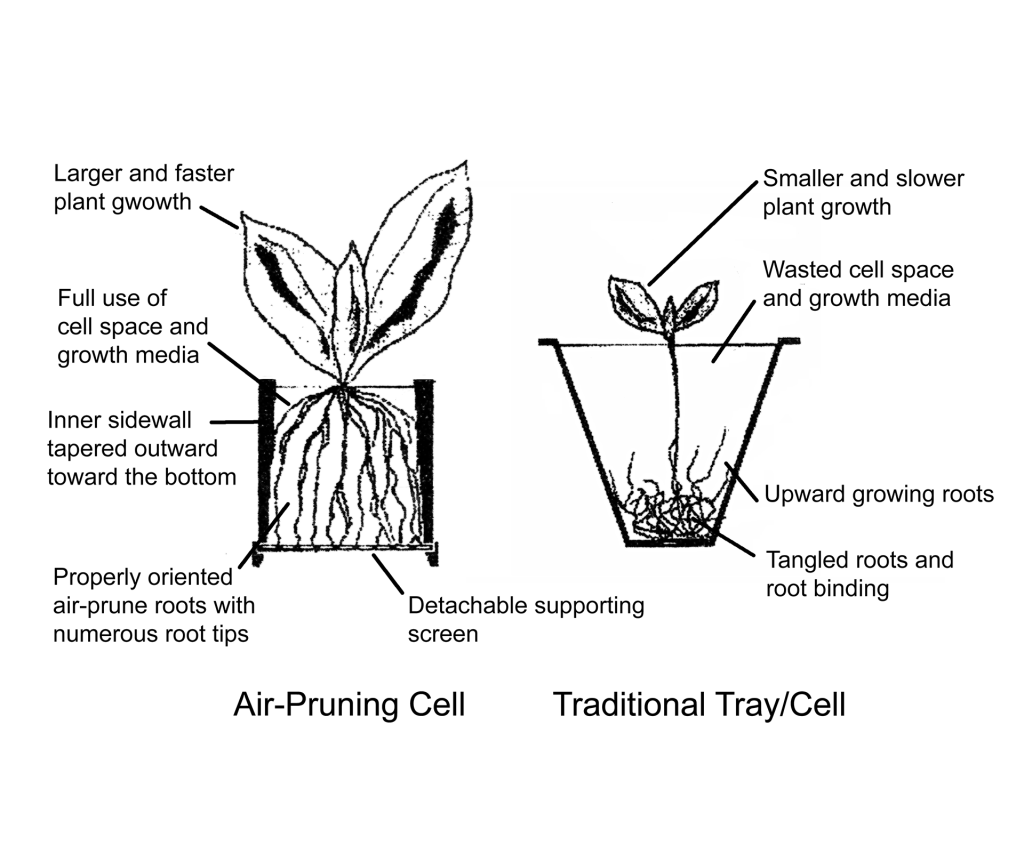
Figure 2.
The bottom line here is that I believe that Dr. Haung’s invention deservers a second lease on life. I’ve got a couple hundred of these trays in stock, as old/new inventory. I’m aiming this post at the gardener, or small produce stand grower who is looking for little bit of an edge when it comes to his or her transplants. I’m going to sell the set at below the cost I paid for these twenty years ago. $10 plus freight for the set.
As a bit of a side note. I also have the mold for these trays and the screen, in case anyone feels as though they would like to pick this product up where we left off. See our New, Old & Misc Inventory page for details.